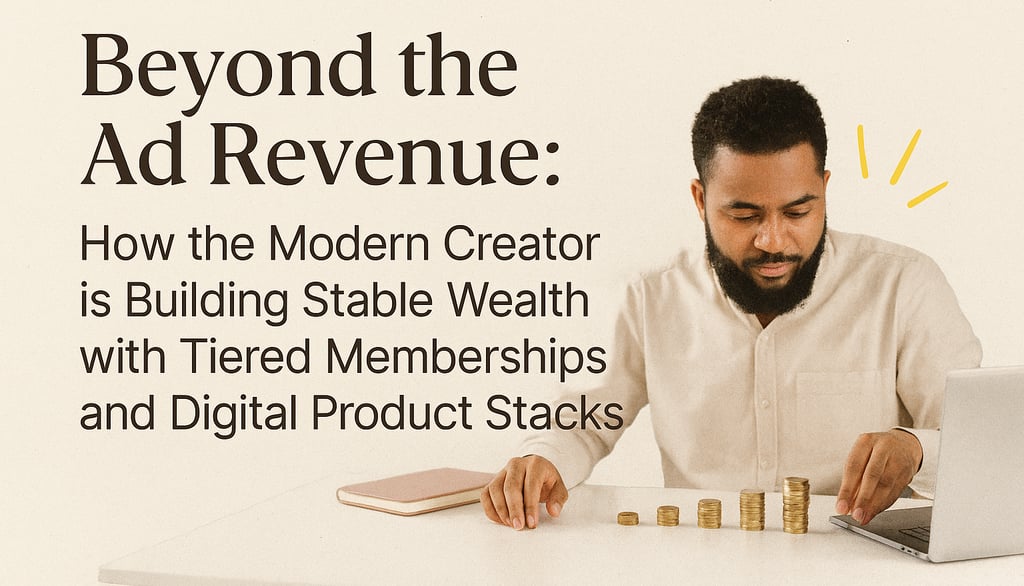
Beyond the Ad Revenue: How the Modern Creator is Building Stable Wealth with Tiered Memberships and Digital Product Stacks
The Creator Economy is maturing into the Creator Business. With platform ad payouts (CPM) proving volatile and disappointing, relying on the algorithm is an extinction-level strategy [1]. Learn how modern digital entrepreneurs are shifting to a Subscription-as-a-Service (SaaS) model: building stable wealth through recurring Tiered Memberships and creating high-margin, infinitely scalable Digital Product Stacks.
THE CREATOR ECONOMY & DIGITAL MARKETING
Apex Digital Content Writing Team
12/2/20253 min read
I. The Creator's Stability Crisis and the Need for Ownership
For too long, content creators lived in a state of precarious affluence. They could earn a great living one month, only to have their income slashed the next by an unannounced change in a platform’s ad policy or a shift in the algorithm [1]. This constant dependence on "rented land" (social media platforms) is fundamentally unstable.
The solution for the modern creator is a full-scale pivot toward Owned Channels and Predictable Revenue. The most successful digital entrepreneurs in 2026 are not relying on views; they are monetizing expertise directly through two highly stable, high-margin strategies: Tiered Memberships and Digital Product Stacks.
II. Pillar 1: The Foundation of Stability—Tiered Memberships
A membership or subscription is the closest a creator gets to a reliable salary, offering Monthly Recurring Revenue (MRR). The key to maximizing its potential is adopting a tiered structure that captures value from every segment of your audience [3].
The Psychological Power of the Three-Tier Model
Most successful subscription businesses utilize a "Good, Better, Best" strategy, which simplifies customer choice and maximizes average revenue per user (ARPU) [3]. This structure is designed to appeal to every level of fan commitment:
Tier 1: Essential (The Entry Point)
Purpose: Converts budget-conscious beginners and offers them a valuable starting point.
Key Value: Exclusive private feed, ad-free experience, and a quick-win resource.
Pricing: Low (e.g., $5–$10/month).
Tier 2: Pro/Premium (The Workhorse)
Purpose: Provides the core transformation and captures the bulk of the creator's value.
Key Value: Includes everything in Tier 1 PLUS monthly live Q&As, access to the advanced resource library, and private forum access.
Pricing: Mid-Range (e.g., $15–$49/month).
Tier 3: Mastermind/VIP (The Revenue Driver)
Purpose: Captures maximum value from super-fans seeking direct access and community.
Key Value: Includes everything in Tiers 1 and 2 PLUS personalized 1:1 office hours, a private mastermind group, and exclusive deep-dive video series or beta access.
Pricing: Premium (e.g., $100+/month).
Best Practice: Value Stacking Always build tiers using value stacking (Tier 2 includes Tier 1; Tier 3 includes Tiers 1 and 2). This makes the higher tiers appear overwhelmingly valuable, encouraging the most profitable customer segment to upgrade [3].
III. Pillar 2: The Engine of Scale—The Digital Product Stack
Digital products are the ultimate form of passive income: they are created once and can be sold infinitely without inventory, shipping costs, or production limits [2]. They scale your income far beyond what your time allows.
The most profitable digital products for the modern creator fall into three categories:
1. High-Value Educational Assets (Online Courses & eBooks)
These are premium, in-depth resources that solve a major problem for the user (e.g., "The 90-Day Digital Marketing Masterclass"). Courses command premium pricing, often exceeding $200–$1,000, and are the fastest way to monetize deep expertise [2].
2. Time-Saving Utility Assets (Templates & Planners)
These are quick, high-margin sales that provide immediate utility. Examples include: Notion or Trello Templates for project management, Canva Templates for social media graphics, or Financial Calculators (spreadsheets) for personal finance niches [2].
3. AI-Enhanced and Prompt Products
A major trend in 2026 is selling proprietary tools that leverage generative AI. This includes custom ChatGPT/Gemini prompt guides, specialized AI-generated asset packs, or templates that integrate with AI workflows [2]. These assets appeal directly to the tech-savvy creator seeking efficiency.
IV. The Synergy: Connecting the Funnel and Owning the Audience
The true secret to stable wealth is using free content and the membership tiers to drive sales of the digital products, and vice-versa.
Lead Generation (The Free Piece): Offer a free, micro version of your digital product (e.g., a "5-Day Email Planning Template") in exchange for an email address. The Email List is your owned channel [1].
The Membership Nurture: Use the membership to provide ongoing community, accountability, and the Why (the philosophy).
The Product Conversion: Pitch the comprehensive digital product (the How) to your email list and to your mid-tier members as the ultimate transformation package [2].
By integrating this Product Stack with a stable Membership Model, the creator is no longer dependent on the whims of a single algorithm. They transition from an influencer to a sustainable, scalable business, achieving true financial independence.
References
[1] Uscreen. (2025). "Top 10 Creator Economy Trends for 2026: Owning Your Audience Matters." Uscreen Blog. (Focuses on the shift away from disappointing platform payouts and the stability of owned channels). [2] MailerLite. (2025). "80+ Profitable Digital Product Ideas to Sell in 2025: Creator Guide." MailerLite Blog. (Details scalable digital products like courses, templates, and AI-enhanced assets). [3] GroupApp. (2025). "Membership Tiers: The Ultimate Guide to Building, Pricing, and Naming Your Levels." GroupApp Blog. (Explains the 3-tier model, value stacking, and pricing psychology for maximizing MRR).